
What is Intelligent-TPK?
Why it matters?
Teachers with strong Intelligent-TPK can align AI use with pedagogy (not just with technology).
They know when and how AI adds value to teaching activities like feedback, differentiation, or formative assessment.
They can design learning experiences where AI supports, but does not replace, student thinking and teacher guidance.
Definition
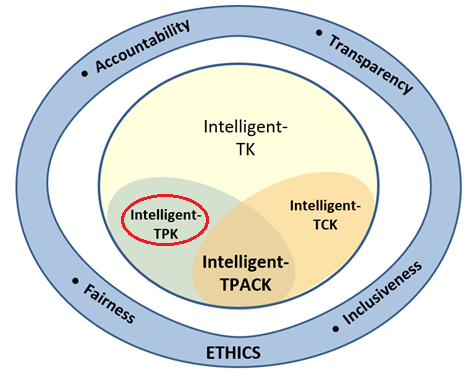
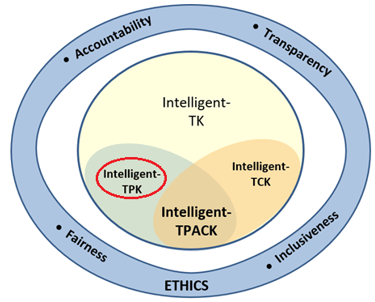
Intelligent-TPK refers to teachers’ knowledge of the pedagogical affordances of AI tools. It includes knowing how AI can support teaching strategies such as providing timely feedback, monitoring student learning, interpreting system messages or recommendations to scaffold learning (Celik, 2023).
*The light green area highlights Intelligent-TPK
(Technological Pedagogical Knowledge)
Classroom Examples for Intelligent-TPK
Reflection Questions for Intelligent-TPK
A teacher uses an AI tool to provide individualized feedback on student essays, then discusses with the class how to apply the feedback in revisions.
During a math lesson, an educator leverages an AI system that generates step-by-step hints when students get stuck, ensuring that scaffolding supports rather than replaces problem-solving.
A preservice teacher experiments with an AI chatbot in small-group work to model questioning strategies, then reflects on how well it stimulated student discussion.

In what ways can AI tools support my existing teaching strategies (e.g., feedback, scaffolding, differentiation)?
How do I decide when AI adds pedagogical value versus when it risks replacing student thinking?
Do I know how to design activities where AI supports but does not dominate the learning process?
How confident am I in guiding students to use AI feedback productively (rather than just accepting it)?